
Really don't mind if I sit this one out.
I'm sick of looking for answers, so I made one up.

Yesterday the Secretary of Random Expulsions and Dog Shooting came to Springfield, Illinois to, I don’t know, yell at us about not being mean enough or something. She had some difficulty finding a place to do it, because her planned target, the governor’s mansion, looked like this:
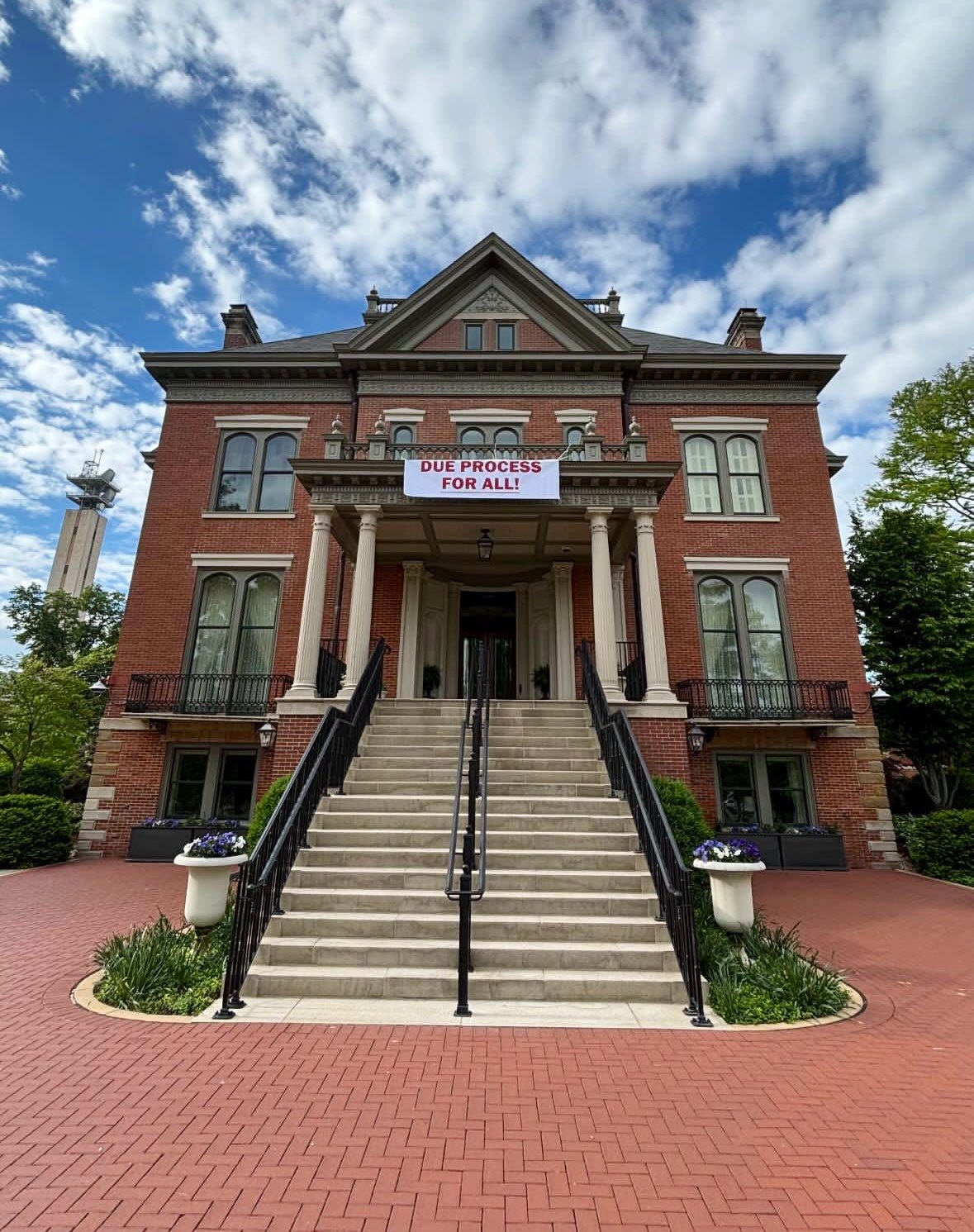
The concept of due process for all was so scary, I guess, that she skipped around town until she found a place where she thought she could make some political hay out of a murder victim’s family, but it turned out that they didn’t really like her that much either. She wasn’t welcomed at all, except by the spouse of Illinois’ craziest legislator. She gave her little speech, our governor patiently corrected all of her dumb bullshit, our Secretary of State somewhat less patiently told her where to get off, and she got to go home with her tail between her legs while claiming victory, like they always do.
I gave the whole thing a miss while it was happening; I’d heard Governor Pritzker telling everyone in the morning to lock up their dogs, so he had it handled. Instead, I went to my “read-read again” pile and landed on “Slouching Towards Bethlehem,” a collection of essays by Joan Didion, to read “7000 Romaine Avenue, Los Angeles 38,” about Howard Hughes.
Now, my entire preexisting recall of Hughes is not expansive, but what’s interesting to me and maybe important to my point should I ever get around to making it is that he was so important, powerful, and influential in so many spheres of American life that it was impossible to get from about 1930 to 1980 without talking about him. I knew about Hughes Aircraft and RKO and the Spruce Goose, but what I remember the best is this bit on Saturday Night Live where Laraine Newman played Hughes out of his mind and bedridden, surrounded by Kleenex and yes-men. A joke, then, in my juvenile mind, mitigated only decades later by Leonardo DiCaprio’s way more relatable portayal of Hughes in “The Aviator” as a man trying everything he can to control his environment against his uncontrollable mind.
Didion’s essay tells a little side story about a guy she meets who had been a costume designer for Hughes’s film production company, who long after stopping his work was contractually obligated not to work for anyone else, seemingly like ever, and had to just sit there collecting a paycheck. There must be thousands of stories like that from people who had been in Hughes’s orbit. It’s easy to imagine oneself in the circumstance of the costume designer. Who wouldn’t want the opportunity to have your work shown in a major motion picture? Maybe a series of major motion pictures? Of course you’re going to sign whatever they put in front of you on your first day of work. You don’t have a team of lawyers to look at it and go, “Now, wait a minute…” and even if you did, not signing it meant that you could just go back to hemming trousers for your kid’s school musical or whatever. You’re not throwing away your shot. And you get to be part of the magic, the production. Something so much bigger than yourself.
We all want that. Don’t we? Do we? Didion gets into how our fascination with Hughes has to do with our belief that money and power equals freedom, but to me here in 2025, that just sounds like supply-side freedom. She was writing in a time before voodoo economics was posited or refuted, but not before Steinbeck saw us all as temporarily embarrassed millionaires, so it’s not like she wasn’t on to something real. Maybe the more enduring part of her point is that people will definitely sign away more of themselves than they intended for the chance to feel enough like they’re part of something greater than they could ever accomplish with their own measly lives. Hughes was never going to trickle down any of the control he exercised, and all those people in his world could ever hope for was a little reflected glory.
But at least for a time, before we all started to make a joke of his illness, he did something, and the people around him did, too, and they were a part of something greater than themselves. For example, while the current iteration of this federal government is scurrying around trying to kick people out of nursing homes, give us all measles, and figure out a way to keep my daughter from getting new eyeglasses, the Howard Hughes Medical Institute is still funding medical and scientific research. So, you know, there’s that. Also, speaking of measly, my five full minutes of research for this piece uncovered the little fact that while Hughes was recovering in the hospital from his shattered ribs, he developed the adjustable hospital bed. If you want to have the grimmest of grim laughs, go to your search engine and ask what the current occupant of the White House has ever done in his lifetime to benefit humanity.
Which brings me to my point. I have been really most sincerely trying, since 2016, to figure out why anyone would think that the situation we find ourselves in right now is on the right track, or anything approaching good, or even not a complete shit show. I once got one person, whom I like, to tell me that he thought his taxes and therefore his cost of living would be lower, but that guy’s been mighty quiet lately, since he understands how tariffs and international trade works and also he is not a slobbering fascist. There simply are no other explanations, not even from the people who probably should have some kind of plan for when they finish tearing apart the state and mining all our data, and the closest thing you ever hear to a plan is some truly unhinged nonsense from the Mary Miller types, yikes.
To be part of something bigger than themselves is an idea, though, that the whole right wing, now meaning the whole Republican party since Reagan, desperately wants but is fundamentally unable to have. They keep trying to have a Movement. Their leaning tower of a leader keeps calling it that, and I guess they’ve even managed to scrounge up some of the superficial trappings a consumer would want in order to feel like there’s a movement, in the same way you’d go to Target to get a t-shirt of some 1969 Pink Floyd concert. They’ve said who is excluded from their movement: the “woke,” nonwhites, nonstraights, women who won’t make them a sandwich, Canada, and probably the new pope. They have a website; I’ve never visited, but I hear it’s pretty heavy on the caps lock. And they have merch, very heavy on the caps lock. And in return for buying the merch, slapping the bumper sticker on the truck, wearing the hat, and maybe hollering a little more hate at the next school board meeting, membership in the movement contains the false reward of not having to think about it ever again.
That’s certainly dangerous - people are disappearing and dying, passing around measles, and the vendetta regime is only a few months in and indiscriminately violent. But we know how this ends. Crazy never fails to crumble under its own stupid weight. This oaf, ultimately, will be forgettable, even more than a joke in the future than now, if you can imagine. In the meantime, we learn and re-learn, like we do every 50 years or so, what direct action is needed to preserve the safety and happiness of the people in our communities, and when they send someone to yell at us, we point them to the sign on the governor’s mansion.
This is an interesting thought and connection. Nice article.
Absolutely love this, Cathy. And you write songs??